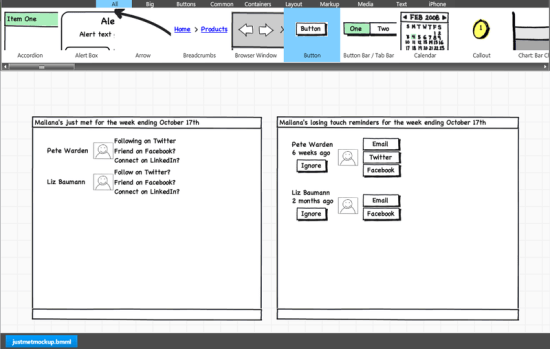
Balsamiq: So simple, even a programmer can use it

Balsamiqshot

Mock me mercilessly, I deserve it, but I've really been struggling to prototype on paper before I code. Back at Apple there was always a white-board handy and a bunch of colleagues and customer-surrogates I had to collaborate with on any feature, so I did plenty of documentation before doing any serious engineering. As a lone founder, it's seriously tempting to think I have a good enough picture in my head to just go ahead and try it out.

Wrong, wrong, wrong! For one thing I end up involving users way too late in the process, since it takes a whole bunch of coding effort before I can show them something. Even ignoring that, I've never thought things through as completely as I think I have. Just a few minutes trying to sketch out the result I'm trying to achieve will always show me something I'd missed, and that's a lot cheaper than spending hours of programming to get to the same conclusion.

One of my mental blocks to prototyping is that I couldn't find a method I felt comfortable with. I'd tried the Pencil Sketch Firefox plugin, but it just didn't work the way I wanted. OmniGraffle is fantastic for creating beautiful diagrams, but it's painful to build something that looks like a UI sketch out of it's primitives. I've fallen back to using pen and paper, but it's really hard to alter and evolve hard copy, and you have to scan it in to share it remotely. Finally I tried out Balsamiq last week, and I'm in love.

I could rhapsodize about its ease of use, but the single best feature is that it looks like a sketch. This visual metaphor is really important, it clearly marks the results out as conceptual designs, not detailed blue-prints. This stops both other people and myself from focusing on nit-picking the look-and-feel, and forces a focus on the big questions about content and placement. I don't spend hours obsessing about aligning elements, because they naturally look a bit wonky, so I'm freed to think about what the overall content should be.

You can give it a try for yourself with the online version, and the full desktop product is $79, though I got it for $40 with a Techstars discount. If you're at all involved in product development, I think you'll end up buying it too.

Blogs I’m reading now

Booklist
Photo by MargoLove

Paul Jozefak just posted a list of the startup-related blogs he's reading, and that reminded me that I'd been intending to highlight some of my favorites too. I'm skipping the obvious ones (Brad, Fred, Eric Ries) to focus on lesser-known gems I'd love to see more widely read.

Bill Flagg

Bill's a Boulder entrepreneur with several great companies under his belt, but what really makes him stand out is that he's a boot-strapper. During TechStars he was a great counter-point to the focus on raising money, and he posts some awesome advice on building a company that actually generates cash. How about a billing department that encourages customers to mark down their invoices if they didn't feel like they got their money's worth? It's working for RegOnline.

Rick Segal

I love Rick's blog because of his willingness to risk offending people. I actually got fairly irate at a post he did last year, but I wouldn't have him any other way. What's even more interesting is that he's recently started on a journey from VC to startup founder, so there's been lots of great "Eat your own dogfood" posts, including a mea culpa on ever uttering the words 'lifestyle business' as a VC.

Highway 12 Ventures

Mark and George were very active in TechStars, but I never realized they blogged until Mark's stellar "Don't let the bastards grind you down". Since then I've been working through their archive, and they're chock full of other great posts, even tips from a hostage negotiator!

Jay Parkhill

Talking of negotiations, Jay's latest post on telling who wants to actually do a deal and who's just there to argue is a must-read. He's a lawyer specializing in startups, so there's loads of other great advice like how to cope with the loss of co-founders without sinking the business.

Accidental Haiku

Haikushot

I've always been fascinated by haiku, and the launch of Drunken Haiku by a good friend gave me a brain wave. There's a massive number of updates on Twitter, some of them must be unintentional haiku!

A couple of hours later, Accidental Haiku was born. It sits on Twitter looking for messages with the right syllable patterns. It's not always perfect at counting the sounds, and being Twitter there's lots of fluff, but if you watch it update I guarantee some gems.

It's all pulled together from open source components and you can download the modified phirehose code here. Now if I could just learn to write good haiku myself…

Haikushot2

Information wants to be free, even at WalMart

 Walmart
Photo by El Neato

I was reading The Wal-Mart Effect when I came across a passage that summed up exactly how I want to change the world. Sara Lee had a business relationship with Wal-Mart, and as one of the negotiators recalls:

Senior officials were always coming down there [to Bentonville] for meetings, and they always had their sheets of paper bent up so the Wal-Mart person couldn't see them. The idea was, why didn't we just put the sheets of paper on the table?

So they opened up traditionally closed information, and immediately discovered ways of saving money that benefited both companies. Wal-Mart had empty trucks returning from Florida that could transport Sara Lee's stock after it was shipped from South America. Underwear cartons were too large, Wal-Mart wasted time and money splitting them to send the contents to different stores, so Sara Lee shrank the carton size. As the book puts it, all of these efforts eliminated pure waste, the equivalent of turning off a light in an empty room.

I spent years in a corporate environment where I saw hundreds of opportunities to save money and make the world better for everyone, if only people would talk and share information. I was surprised to see I had that in common with Wal-Mart, but it makes sense given their fanatical approach to efficiency. If you're really trying to be productive, it just doesn't pay to be secretive.

Are there downsides to this? One of the biggest hurdles is trust. Knowledge is power, so you're handing over power to people who's interests may not align with yours. Wal-Mart is the 800lb gorilla with a history of using its market power ruthlessly, and one of the strengths of the book is its detail on the negative side of their dominance. I'd argue that this trust argument is usually a cop-out, hiding worries about turf and control. In most cases it's clear that it's not in the other party's best interest to screw you over, and if it is, why are you dealing with them at all? The worst cases I saw were between departments within the same company, often we shared more information with competitors than the guys down the hall.

Once you're in a business relationship, there's a lot to be gained by putting all the sheets of paper on the table.

A lovely little online icon editor

Iconfushot

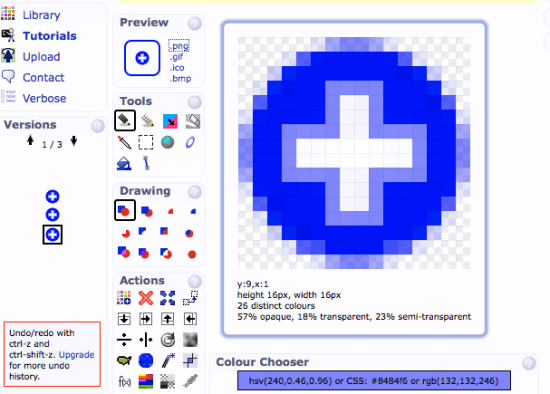
My design skills are non-existent, but I often need functional little buttons or badges. Using Photoshop for that sort of thing is like taking a sledgehammer to a nut, so I was extremely happy when I found iconfu.

It appears to be pure Javascript, which is impressive just as a technical feat, but it's also an extremely usable and surprisingly full-featured tool for building tiny icons. It's got undo, nicely anti-aliased primitives and some handy filters. Even better, it's completely free for up to 16×16 images. It's no Photoshop so don't expect to see layers or freehand, but that's part of what I love about it. It takes me back to the paint programs I'd use in the late 80's, and the hours I spent clicking individual pixels to create a massive 320×240 demo background.

The only drawback is that Internet Explorer is not supported, but if doing any web design work I'm sure you'll have a better an alternative browser installed anyway.

Get visual bug reports with SnapABug

Ladybug

Photo by Hamed Saber

One of the most frustrating parts of trying to fix a customer's problem is trying to understand what on earth the problem is. I've spent enormous amounts of time bouncing emails back and forth, or talking on the phone, just to get enough information to start debugging. I've long been a fan of tools like CrossLoop that let you share screens with a remote user, but I'm really excited to see what my fellow Techstars alumni Timzon have come up with.

SnapABug is a small widget you can include in any web page, and it gives users a button they can press to take a screenshot and email it off to your support team along with some notes. Dead simple but incredibly useful! Jerome, Jerome and Tony have done an awesome job of identifying a great market for their technology, I can definitely see this appearing on a lot of sites and becoming a valuable product.

A coming privacy freakout?

People don’t know how much information about them is freely available on the internet. I was reminded of that by this thread on the WebFinger list about a prototype YQL implementation that lets you look up information about any Yahoo user from their email address. I’ll quote Kaliya:

I went and tried the page out to see what it exposed about me.

Both for my “public” use around the web a lot yahoo handle and another one
that I have explicitly kept my “real name” not attached to in any public
forums.

My name listed in both accounts was Kaliya however when you expose people’s
“profile names” in web finger you might be exposing information people don’t
think is public on the web.  Needless to say I went in and immediately
changed my profile name in my more private account.

I just shared this with guy friend who has several yahoo accounts – one of
them for dating.  I said do you have your “regular name” listed in the
“profile name” – he thought he might. It sort of made him cringe that this
was now exposed.

I think you might have a real uproar from users by exposing their profile
names publicly on the web without letting them know you are doing this. It
would be good to send people a note asking telling them this information
will be exposed to ANYONE WHO ASKS before you make it available via
webfinger.

I was thinking about the difference between twitter and almost everyone
else.  Twitter starts at Radically Open and explicitly so – so as a user I
know what bargain I am striking in using the tool.

Everyone else is trying to go from “closed” as the default and move towards
more open and pulling users along is a challenge – it is changing the rules
of the space and it needs to be well thought out or it will back fire badly.

The response from the developers has been ‘Silly user with your expectations of privacy! Didn’t you know there’s been a Yahoo profile page with that information up for years?’ That’s my instinct too, there’s so many wonderful new services we can build with more open profile information, and we’ll never get anything done if we spend all our time sitting around worrying about potential problems.

From talking to people outside the bubble though, I do wonder if there will be trouble ahead. They don’t know that Facebook puts up a public profile for them by default, with pictures, your location and some of your friends all open to the world. Services like Flickr, Amazon, Google, AIM, Vimeo all provide APIs to look up information about someone based on their email address. Rapleaf claims to have social network infomation on 375 million people. If you’re interested in the information that’s available on you, try this example:
http://web.mailana.com/labs/findbyemail/

The worst case is that we plow ahead with what’s technologically possible, trigger a moral panic and we end up with restrictive legislation, but even a mild backlash would cause providers to neuter their APIs and remove access to all that lovely data. So what’s the answer? I’d love to see something like the apparently defunct attentiontrust.org pledge to help us self-police our use of the data, before someone else comes in to police us!

The case against the Founder’s Visa

Immigrantbowling
Photo by Vaguely Artistic

In my last post, I talked about why I'm in favor of tweaking the immigration system to provide a Founder's Visa. It's reasonable to ask what the downsides might be, so I thought it might be useful to lay out some possible objections and how they can be managed.

Gaming the system. Will people be able to pretend to be founders to get into the country? As Pat put it, can I just open a restaurant to claim the visa? The safeguard here is money. The proposal is that you need to have over 10% of a company with $250,000 raised in a recent investment. Once the founder's in the US, that investment will flow into the rest of the economy. It's already possible to get a visa if you self-fund a company with a large investment, the main change here is to open the door to raising money from external investors.

So could you figure out a shady deal to fake the investment? Certainly people have been caught using undeclared loans to raise the money needed for the standard E2 visa, but this proposal doesn't make that kind of fraud any easier.

More spaghetti code
. I grew to loathe the forest of obscure rules that make up the immigration system. It's truly mind-blowing how hard it is to get a simple answer to any question, there's so many special cases built-in. It's like a piece of code where years of bugs have been patched by adding yet another if statement to a monster function. The system fundamentally doesn't work, whether your goals are to reduce immigration (it has all sorts of obscure loopholes) or provide a fair way to encourage productive immigrants (it's so complex there's no guarantees you'll be able to stay).

I'm a big fan of the Canadian points system, where they give points for attributes they want in immigrants, like college degree, or work experience in an in-demand industry, and accept those with a score above a threshold. The Founder's Visa is yet another patch to the system, adding a little more complexity to the process, rather than the true overhaul it needs.

That said, I don't see any practical way to do a proper fix of the system, so patching it for this special case seems like the least-worst option.

Giving too much power to investors. There's a delicate balance of power between investors and founders, and knowing that the founder's very presence in the country depends on that term-sheet will give investors a lot of leverage during negotiations. A lot of founders are pretty nervous about this aspect, but I'm more sanguine. If you're a first-time founder getting investment, you're likely to be in a weak position anyway, and are to a large extent relying on the investors being sensible in their demands so that they don't weaken your motivation to make the company a success. In theory this tips the scales against you even more, but in practice the investors have their thumb on the tray anyway.

I'd like to finish by highlighting a comment from someone who ended up in prison for two days after he reduced his class schedule while here on an educational visa! My story's actually pretty tame, I know plenty of people who ended up having to leave the country, so I'm grateful mine has a happy ending.

My immigration story

Starsandstripes
Photo by Kalwa

I'm a big supporter of the Founder's Visa idea, but to anyone who hasn't been through the US immigration process it may be unclear why it's so important. I loved the way Manu Kumar talked about his experiences, so to contribute to the debate I'm going to give a brief run-down of my 7 year journey through the bureaucracy. A lot of friends and colleagues have been through the process too, so I know my story isn't particularly remarkable, but it may shed some light on why so many talented people give up on moving to the US. It's actually pretty long and boring, but that's kind of the point!

When I was 18, I maxed out my credit cards and took a three-month vacation in Juneau, Alaska, teaching archery at a boy scout camp in return for lodging. I fell in love with the US, there was a freedom here I'd never even imagined at home.

Back in the UK I completed a BS in Computer Science at Manchester University, which I'd chosen because of their awesome history in computers, with teachers from Turing to Steve Furber, designer of the ARM chip. After that I spent five years diving into game programming, and became a specialist in programming console GPUs, starting with the original Playstation, and moving onto the PS2, XBox and Gamecube.

The lure of the US was always in the back on my mind, and once I'd finally paid off my college loans and credit cards, I decided to take up one of the recruiters who kept contacting me, and spend some time working for an American company.

I ended up getting a job at Left Field, based just outside of LA. I accepted their offer in March 2001, but I had to wait until August for the H1B visa application to make it through the INS, not for any errors in the paperwork, that was just how long it took them to look at it.

By the time I got there, only 3 months were left on the project, but I had enough experience I was able to dive in and make a contribution. When the project was over, my manager took me aside and told me he and several other folks were leaving to start their own company. I eagerly followed, and for once the visa transfer process was trivial.

I stuck it out at the new company Kush for a year until the first project was done, but at the point where I was working 90 hour weeks and then got reprimanded for being late on a Sunday, I decided I needed a change. Over the last couple of years I'd developed some open-source image processing plugins to help out with my hobby of providing visuals for clubs and concerts, and I'd recently ported my 40 filters over to After Effects. I was astounded by the response, I'd stumbled into a market where people were charging several thousand dollars for a handful of effects, and I could produce popular ones very easily!

So, I left Kush and set out to build my own company with commercial versions of my effects. Unfortunately I quickly discovered that even with my modest savings and a proven market there was no way for me to set up a company in the US. As luck would have it, Apple approached me on the basis of my open-source technology, offered to buy what I'd created so far and give me a job. The most important part was they not only offered an H1B, they would also sponsor me for a green card.

Predictably the H1B process took longer than expected, and I was stuck back in the UK for 6 months again before I could start at Apple. Once I was there, I had to wait a year before the company would start the sponsoring process. Then, I began the first step, 'labor certification', basically proving my job was so specialized I wasn't shoving an American out. Once all the paperwork was in, I waited and waited, and it took over two years for them to finally look at my application. It was approved, and I was overjoyed, until I dug deeper through the results and realized my lawyer had filed me for an EB3 not an EB2. She'd mistakenly put me down as an unskilled worker, which would mean a decades-long wait! I had to refile under the right designation.

This time it went a lot more quickly, and I got the right certification back, and moved onto the next stage in my green card application. After lots more paperwork, including a medical examination to ensure I wasn't a psychopath or sexual deviant, I was back in another queue. This one took around 18 months, mostly because I got flagged for an FBI background check. I understand the need for checks, but it seemed slightly crazy that they had such a long delay, everyone was already resident in the US so anybody dangerous had a long time to get up to mischief.

Finally my green card came through in May 2008, five years after I started the process with Apple. The biggest sensation was relief, I could finally make plans knowing I'd be here permanently. I tidied up my work with Apple, and was free to start Mailana two months later in July.

So what's the point of this story? I love Apple dearly, I can't imagine a better large company to work for, but I'm a startup guy at heart and I ended up taking the corporate path for a long time purely because of visa issues. The Founder's Visa would have offered me a chance to create my own company much earlier, and hopefully employ a lot of Americans too! Beyond that, there was a constant sword of Damocles hanging over me all the way until I got my green card, at any point a paperwork SNAFU or employer decision could have kicked me out of the country.

How to follow your Apache error logs in a browser

Pawprinttrail
Photo by Hunting Glee

As I work to make the data import process more reliable, one of the patterns that was recommended to me was having your import processes append their results to a log file, and then have a database load process that watches the file and updates the database as it spots new content.

This potentially solves a lot of problems for me, but it's not at all obvious how to implement the file tailing functionality in PHP, so I implemented a standalone example to test some approaches. Since I've always wished there was a better way than ssh-ing into my servers to view a live version of the Apache error logs, I made the example a long-running PHP process that outputs updates from the logs to your browser. You can see it running here:

http://web.mailana.com/labs/logviewer/

The code is downloadable as logviewer.zip, or it's included below. Be warned, before you use this on a production server make sure it's password-protected, since sensitive information like passwords or credit-card numbers might leak into your error messages inadvertently!

If you're looking for a Perl version, you might want to look at the File::Tail module.

<?php

//! This function never exits!
//! It sits on the specified file, calling the process function for each new line of
//! input as it's appended by some other process. The cookie value lets you pass in
//! an opaque object to be used by the process function callback.
function tail_and_process_file($filename, $processfunction, $cookie=null)
{   
    $retrycount = 0;
    while ($retrycount<5)
    {
        if (file_exists($filename))
            $retrycount = 0;
   
        $filehandle = fopen($filename, 'r');
        if (!$filehandle && file_exists($filename))
            die("tail_and_process_file($filename, $processfunction, $cookie): The input file exists but I couldn't access it");
       
        $lastaccesstime = 0;
        $lastfilesize = 0;
        $lastfileposition = 0;
       
        while (file_exists($filename))
        {
            $currentaccesstime = fileatime($filename);
            if ($currentaccesstime!=$lastaccesstime)
            {
                $currentfilesize = filesize($filename);
                if ($currentfilesize<$lastfilesize)
                {
                    $fclose($filehandle);
                    $filehandle = fopen($filename, 'r');
                    $lastfileposition = 0;
                }
                       
                fseek($filehandle, $lastfileposition);
                while (!feof($filehandle))
                {
                    $currentline = fgets($filehandle);
                    if ($currentline!='')
                        $processfunction($currentline, $cookie);
                }
               
                $lastaccesstime = $currentaccesstime;
                $lastfilesize = $currentfilesize;
                $lastfileposition = ftell($filehandle);
            }
           
            // Without this, the results of the fileatime() may be cached
            clearstatcache();
            sleep(1);
        }
       
        // The file no longer exists, so wait a progressively longer interval
        // and try it again. After too many retries, die with an error
        $retrycount += 1;
        sleep($retrycount*15);
    }
   
    die("tail_and_process_file($filename, $processfunction, $cookie): The input file was not present after multiple retries");
}

?>