Five short links

Fivefingers
Photo by Jane Rahman

What do prototypes prototype? – In my last post I explored some of the problems with our model of prototypes, which inspired Joe Parry to point me at this in-depth paper. Very thought-provoking ideas on there being three axes to classify prototypes by; implementation, look and feel, and role.

How telephone directories transformed America – A hundred years before Facebook, our social structure was transformed by a book that listed our names and addresses, and gave strangers a way to contact us directly. I've often used the phone book analogy when discussing privacy, but I'd never really understood what a major shift it actually represented.

We ten million – That's a guesstimate of the number of aspiring novelists out there. Whenever I get daunted by the difficulty of making it with a startup, I remember all the amazing artists and writers I know who'd kill to share the odds we have. My favorite advice for success is "I was neither the most talented nor the most clever writer in my writing group, but I was the one who stuck with it." I hope that works for founders too, since my only super-power is the iron-plated stubborness I inherited from my grandmother.

Some cool things I heard in New Zealand – Sounds like a fascinating conference, gathering together 300 CEOs from the design world. Lots of great quotes, but the most insightful was "When asked why Method keeps innovating, he answered 'our people give a shit.'". I know exactly what he means, you can tell within a few minutes of dealing with most companies whether the people there actually care, or if they're so beaten down they're just picking up paychecks.

Exercise more to hack better – I smoked and barely exercised until I was 25 and moved to the US, but starting made an amazing difference in my own productivity, and in my general quality of life. It's funny, but I'd always assumed exercise made you tired. In fact that endorphin cocktail has been so helpful I try to get in a decent workout every morning, just to keep me on the ball with my work.

Works like, looks like

Dolllamp
Photo by Julian Wearne

My friend Nick Napp introduced me to some new terms when we were discussing prototypes a few days ago. In the toy industry they classify their experimental versions of products as 'works-like', 'looks-like' or 'works-like, looks-like'. As you might guess 'works-like' prototypes demonstrate the functionality that the designers are after, but look nothing like the intended product, 'looks-like' means that you have an empty shell that doesn't work but reflects the intended form, and 'works-like, looks-like' is a more traditional prototype that has both the form and function.

I love this language, because it gives us a way to express some of the lessons we've been learning in the web industry. Traditionally in engineering disciplines the risk is that your technology won't work – that the bridge will collapse after you've built it. That was true in the early days of the web, we had no confidence that we could build a photo upload site that would actually work, so we got into the habit of testing the functionality through prototypes. In our minds, the only kind of prototype was 'works-like'.

A lot of the most interesting recent techniques for startups are focused on reducing market risk instead of technology risk. I see everything from running AdWords campaigns that lead to a shell landing page for your hypothetical product, to powerpoint-prototypes or photoshop mockups as 'look-likes', because they're intended to answer fuzzy questions about people's superficial reactions to the products.

Our current problem is that we've overloaded the term 'prototype' to mean both kinds of experiment. I've seen the confusion and frustration that this causes, as engineers use the effort to try and answer technical questions while the business folks gnash their teeth at the slap-dash styling that makes it useless for showing to potential customers. If we adopted the terms and mindset that they're actually two different things, then we'd have a better chance of modularizing our design process to answer those questions separately, and then have a final synthesis phase where we try to bring them together into a 'works-like, looks-like' final prototype. I found this article from the D School very enlightening on the way traditional product designers apply the same technique.

I'm going to try to clarify my thinking about the design process by using these terms going forward, and I'm curious if anyone else has run across anything similar in the web world?

A mistake

After sleeping on it, I realized that my commentors were right to gently and not so gently chastise me for using the Holocaust as a rhetorical device in my last post. Bloodlands had a powerful effect on me, as have many other books on the various horrors of the twentieth century. They left me with a lasting sense that we have to actively fight against anything that could lead to their recurrence, which was the goal of that post. Unfortunately the route I took reduced the complexities of history in a way that comes across as very glib, on a subject that demands a deadly serious approach.

Almost a decade ago, I was sitting next to an old man and his daughter at a breakfast counter in California, and we started chatting. Casually he lifted his sleeve and showed me the number tattooed on his arm, asking if I knew what it was? I immediately understood he'd been in a concentration camp. He told me that as time went by, fewer and fewer people recognized it. We only spoke for a few minutes, but that encounter has haunted me since. It's easy to treat the Holocaust as dry history, a subject to weave clever arguments around, but it's still a living breathing horror for many. I'm sorry, I made a mistake when I treated it the way I did.

Data, Story Telling and Mass Murders

Nazipropaganda
Photo from the Calvin propaganda collection

I've just finished Bloodlands, a scholarly but powerful overview of the millions of killings committed by both the Soviets and the Nazis before and during World War II. What was especially striking was how little the murders relied on technology. I was more familiar with the western portion of the Holocaust, which required an elaborate system of transportation and bureacracy to carry out its murders. Most of the eastern victims were simply rounded up where they lived, forced to dig their own graves and then shot.

This is important because the threat model we use for privacy is based on the dangers of giving a state bureacracy too much information about our lives, to feed into a sophisticated Big Brother operation that constantly monitors us. The chilling examples of both Germany under the Nazis and communism demonstrate how much truth there is to that fear, but I think it also causes us to miss other risks.

Think about the Rwandan genocide. The killings weren't carried out using a sophisticated organization, it was people killing their neighbors with machetes. What the Nazis, Soviets and Rwanda all had in common was a sophisticated and effective propaganda campaign. They successfully convinced large numbers of people that unarmed men, women and children were deadly threats who had to be exterminated. Hutu broadcasters branded Tutsis as 'cockroaches', Nazi propaganda claimed Jews poisoned Aryan children, Stalin claimed the Ukranians were deliberately witholding food and causing starvation.

Story-telling like this is a vital component for every genocide. Killings on that sort of scale require active effort from hundreds of thousands of people, and passive acquiesance from millions. This requires a massive amount of motivation, and the only way to drive that is through effective propaganda.

What this doesn't explain is why the propaganda succeeded so well in those particular cases but not in others. My theory is that the recent introduction of new communications technologies should take a lot of the blame. The Nazis were able to harness films and radio to spread their message, the Hutus used radio almost exclusively. What the situations have in common is an elite who discover a way to tell stories in a very powerful way, thanks to a previously untapped medium. They succeed because the audience lacks a healthy scepticism. Stalin could edit people out of photos and be believed because 'Cameras don't lie'.

In this model, a new form of media is like an infection hitting a previously unexposed population. Some people figure out how it can be used to breach the weak spots in the audience's mental 'immune system', how to persuade people to believe lies that serve the propagator's purpose. Eventually  the deviation from reality becomes too obvious, people wise up to the manipulation and a certain level of immunity is propagated throughout the culture.

What does this have to do with our work in the startup and data worlds? I'm passionate about this area because I truly believe it can change the world. The downside is that history shows the power inherent in any new communications tool is often abused by evil people. Why should what we're doing be any different? I've already had some of my visualizations used by 'White Power' groups to argue that the US is being taken over by Mexicans, thanks to a few border counties where Jose pops up as a common first name. In general I'm worried by the lack of scepticism about the truth behind the results of large-scale data analysis and visualization. My Facebook map was a Saturday afternoon effort with a paint program, the methodology would never survive peer review, but it still ended up getting discussed very seriously in influential publications. As long as a visualization has decent-looking production values, or an analysis claims to use a sufficiently large set of data, most people will take it at face value, no matter how murky its hidden foundations. You might call this the Freakonomics Effect; while their arguments are backed up with real evidence, a lot of people have copied the same form without putting in the hard work needed to be as sure of the conclusions.

What's vital is that we take responsibility for the effects of the tools we're creating. In practical terms that means relentlessly pushing journalists to improve their understanding and scepticism of our results, and taking a stand when we see bogus work being promoted. We need to have standards we expect reputable data scientists to adhere to, and demand enough information and reproducibility before we take data-backed claims seriously. Science polices itself thanks to an informal community structure, we need to learn lessons from that. If we don't, then our wonderful new tools will just end up being hijacked, and mislead instead of enlightening.

Five short links – Security edition

Padlock2
Photo by Darwin Bell

Now I'm looking at handling more sensitive customer data I have an obligation to do everything I can to secure my server and code. Here's five resources I've found helpful:

Nikto – This tool runs an external scan of your webserver and spots common problems. The most serious mistake it found was that I'd forgotten to disable automatic indexes for directories without an index file.

Snort – Snort is an open-source intrusion detection system, and was pretty straightforward to get up and running. In its basic form it will just log suspicious events to a file, but it can be set up to use a database and send notifications too.

PHP Security Guide – A short, clear guide to the most common security errors in sites driven by PHP. The section on session fixation and hijacking was especially surprising to me, and I ended up rewriting some of my code to patch problems it alerted me to.

Browser Security Handbook – Google's guide is a comprehensive look at the flaws and pitfalls of the browser security model, and is essential reading for anyone building Javascript applications. It's sometimes a bit overwhelming though, because it covers the problems in so much depth.

Salesforce's security page – Salesforce would lose a lot of sales to traditional rivals if users were bitten by security problems related to their cloud-computing model, so ensuring their external developers write secure code is important to them. The result is an excellent set of documentation that's widely applicable, even if you're not working with Salesforce. Their self-assessment tool in particular was a great starting point for an internal security audit.

Five short links

Spockfive
Photo by Mitchell Gerskup

Kaggle – A site dedicated to improving our data analysis algorithms by running frequent Netflix-style contests. Both the data providers and the scientists win, I think this is an excellent idea and I’m pleased to see it looks like there’s been a lot of uptake – via Anthony Goldbloom

Storytelling, statistics and other grave insults – “Statistics is often too dry and too abstract for us to understand intuitively, to generate that comfortable internal feeling of understanding“. There’s a lot of truth in this analysis of how we crave, and believe, narratives. Stories persuade in a way that numbers don’t.

The Illogicality of Stock-Brokers – In a similar vein, this study shows how even experts let their intuition override basic logic. The authors experimented by posing trading questions to experienced stockbrokers, and found that the plausibility of the answer strongly determined whether they chose it, even if applying simple logic would clearly show it was wrong. More evidence that we rely more on our pattern-matching skills than our rationality when making decisions – via FreeExchange

myWorld Demo – The web opens up so many ways of putting advanced geo tools like this into the hands of everyday people – via Peter Batty

Datavis Tumblr – Beautiful examples of data visualization – via Julian Green

How to use the new Salesforce REST API from PHP

Catnap
Photo by Napanee Gal

Salesforce just released the REST version of their API, and while there's a Java example, there's no sample code for other languages. Since I'll be calling it from PHP, I used their documentation to build my own sample code. The source is available at http://github.com/petewarden/salesforce_restphp_example/ and you can see a live version running at https://www.openheatmap.com/labs/salesforce_restphp_example/. The code demonstrates how to authenticate, get an access token and then call the API to grab information about the sales accounts for the current user.

To use the API at all, you'll need a server setup up with an SSL certificate and https, since the OAuth 2.0 authentication requires a secure connection. I found this guide from Ubuntu useful in getting that set up, and bought my certificate from GoDaddy.

With that sorted out, go to http://developer.force.com/join to create a Developer Edition salesforce account. You'll also want to sign up for the REST API preview beta program (though they're currently experiencing a few technical hiccups with the process).

Next, navigate to the Setup link in the top-right corner of the page, then click on Develop, then Remote Access. Pick an application name, and add the location where you'll be uploading the example index.php file as the callback URL. I also checked the No user approval required box even though I'm not sure exactly what it does! After you've saved you should see a screen giving you your access credentials. Copy the Consumer Key, Consumer Secret and callback URL values into the start of your copy of the index.php sample code and then upload it to the server.

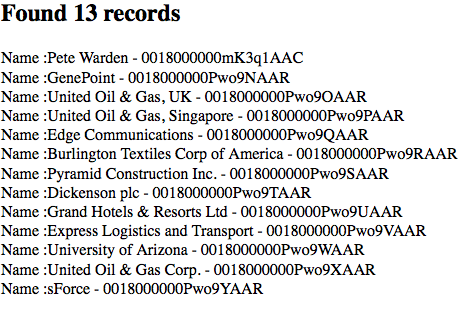
Now point your web browser at the address you uploaded the sample code to. The first time through it should redirect you to a login page on the Salesforce site, ask you whether you want to let the application access your data, and then send you back to the sample code location. If all goes well, you should see a list of your sales accounts:

Salesforceshot
Congratulations, you've just written your first Salesforce application!

The dark side of entrepreneurship, continued

My last post led to a flood of comments and emails. There's so much sobering insight packed into the reactions, so many personal stories that stand out, I'll highlight a few of them below.

First though, I want to talk a little about the connection between my work and the failure of the relationship. As I said, there wasn't a direct, clear link. I fought hard to carve out time to spend together, since I knew that was the classic mistake. It was more subtle – when at some level I started to sense deeper problems with our relationship, I'd try to spend more and more time together as a fix instead of talking about the issues and confronting them. I had my work to soak up any frustration and bring me some measure of satisfaction, so I let things linger. Looking back, I should have known what was going wrong, but it was easier to hide in the world I could control than face painful conversations. I shut myself off, and left her facing our problems alone. When she finally had the courage to confront me with them, she felt it was too late for a fix. It wasn't that work kept me physically away, it's that it gave me a place to hide from our problems.

123 wrote:

"I know how it is to be on the other side of the story. It's hard for us too. I'm really sorry."

That's what I'm going to regret for the rest of my life, the pain I caused someone I love.

Alex Dong paints a picture of where I could be in 50 years time if I'm not careful:

"When I met Frank, he was 97. Just came back from his first accident falling off from stairs. A visit to his house was like a tour of the car history museum. He was there when Ford was just starting up. Frank invented a shitload of gadgets and mechanical devices that made the model-T possible. Most bleeding edge technologies they created have long gone. Today we don't even have a chance to see them anymore. Like a reflective mirror on top of the front light that can tell the driver whether the light is on or not. He was so lonely by then that he took us for a ride in his still brand new Ford Model A and refused to stop and let us go home.

Frank's personal life was a complete failure. He was so passionate about changing the world that he had a workshop at home, with lathe and tons of great manual tools. His wife became an alcoholic because Frank completely ignored her. His two sons hated him so much that none of them came to visit him in the last 5 years.

A month ago, I heard that Frank finally moved into a nursery home. He sold his house before he left. My friend Walter was there when one of his son hired a dumpster to take away all Frank's tools. The whole workshop was thrown away. Nobody, even a museum, wanted his stuff. All the great books, models, designs, gadgets. All into the dumpster."

Jud Valeski talks about the impossible balancing act:

"Thanks for the honesty. I'm sorry this happened. The apparent out-of-the-blue nature scares me. Things seem "fine" in my world. I fear coming home one day to an empty house and a note on the table.

There are so many conflicting desired behaviors between work and non-work relationships. In order to make my company succeed, I have to pour everything I have into it. In order to make my marriage and parenthood succeed, I have to pour everything I have into it. What the!?!

Over the past six months, since taking on the CEO position at work, my world has shifted. Even more than before, as a founder, my time is absorbed by work. I've never been good at balance, but I like to think I'm doing ok with it. I get support from my spouse (tremendous support), but I don't know how real it is. Not because she's potentially dishonest, but because I don't know if these are the kinds of things that even she can know in the moment (can any of us?). I can't ignore the frustration in her voice when talking to her on the phone on a work trip asking "how many more nights are you gone?"

For better or worse will be determined in time, but we've split the balance up at a unit level. We've curiously fallen straight back into the 1950's; I bring home the bacon, and she runs the house and kids. I try to be a good father by showing my children what hard work means. What it means to dedicate yourself. What it means to be passionate. What it means to run fast. What it means to pick yourself up after you face-plant. What it means to work and love. What it means to love work. Those are the examples I can give. That is my life. That is how I can contribute to our child rearing as a parent. It's not necessarily my preference, but it's what I can do, and do well, at the moment."

Adrian Ashton on the hidden costs behind work we admire:

"I occassionally get to guest lecture to enterprenuers clubs in colleges and universities and always end with an image of Edward Much's 'Scream' to illustrate the point that the piece of art has changed the world, touched and changed countless lives… and all it took was for the artist to have a breakdown."

Mitch Fillet on a time limit for startups:

"It is very hard to navigate the desire for achiievement, the demands of your employer aas they heap on both responsibility and compensation and the needs of your family.
Wrap those demands woth some aging parents and a few chldren and it becomes an almost impossible cycle to shoulder for more then a year or two. That is why we speak about a 36 month exit of some sort. This, of course, does not mean an IPO. It just means a recognition that a combination of delegation, infrastructure build-out and possibly the inclusion of other stakeholders preserves the sanity and family of the founder group."

Nicholas Napp on the sacrifices you have to make:

"We talked and agreed that there needed to be more ground rules other than simply keeping to the truth. If you're not willing to sacrifice your relationships (something I am no longer willing to do) you have to make other compromises. That's why I now have a startup and a consulting business. Yes, VC's hate the idea, but they're not the people I want in my personal life.

For me, there has to be more balance. You can't stay happy and walk away from your passion and a desire to build things, but that passion can easily blow up the rest of your life. Being hyper focused on work is the natural tendency for an entrepreneur, but for most of us, I don't believe it's effective. You lose perspective, miss opportunities and make mistakes. Not that you don't make mistakes otherwise, but at least if my work life sinks, I have a rich personal life to anchor me. That gives me the chance to reset and try again."

Kin Lane on sharing the obsession:

"Definitely an area that young entrepreneurs do not consider. My marriage eventually ended after 10 years due to my chronic entrpreneurialism.

I still suffer from it, but manage it better these days. Also found an equally geeky, obsessive GF….and our obsessive world is shared. "


The dark side of entrepreneurship

My work has never been better, but my personal life is in tatters – an eight-year relationship just ended. I probably shouldn't even be discussing this here, but writing it down helps as I try to make sense of what went wrong – what I did wrong.

There's no direct line I can draw between what happened and my startup life, but I have to wonder. Something people seldom talk about with entrepreneurship is how corrosive it can be to relationships. Founders are driven, and that doesn't make for a comfortable world for them or those around them. I always tried to make my home life the top priority, but my obsession is a part of me.

There's so many characteristics of entrepreneurs that make us hard to live with, from a constantly uncertain future to long working hours and a monomaniacal focus on our projects, but these tend to get lost in the classic Romantic mythology that is perpetuated by our willingness to lie about the reality of startup life. There's plenty of counter-examples that show it's possible to be a founder and a good spouse or parent, but the 'craziness' that drives us to build castles in the sky is not always a benign force.

Please, take a minute to think about the people you love, and be certain you're giving them everything they deserve, that you're truly there for them. I have lots of time to reflect on that, now it's too late.

OpenHeatMap now supports states and provinces worldwide

Afghanexample
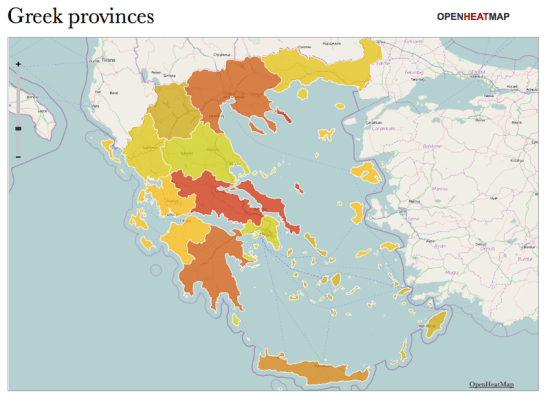
One of the most frequent requests for OpenHeatMap has been better support for provinces/states outside of the ones I already offer. The bottleneck's been finding the data in a form I can use, with a lot of help from locals I found a handful of usable maps for India, Mexico and Canada, but it was a slow process. All that changed when I discovered the public domain Natural Earth data set. Taking one map containing top-level administrative districts for every country worldwide, I was able to extract the states and provinces for hundreds of nations. This means you can now upload a spreadsheet containing province names for almost any country and get a detailed map.

This is the map you get when you upload Afghan provinces, and below is a complete list of the examples for the countries I support. I'm very excited to see how people are able to use this, so let me know how you get on.

Greekprovinces

Afghanistan
Angola
Land Islands
Albania
United Arab Emirates
Argentina
Armenia
Australia
Austria
Azerbaijan
Burundi
Belgium
Benin
Burkina Faso
Bangladesh
Bulgaria
Bosnia-Herzegovina
Belarus
Belize
Bolivia
Brazil
Barbados
Brunei
Bhutan
Botswana
Central African Republic
Canada
Cocos (Keeling) Islands
Switzerland
Chile
China
Cote D'Ivoire
Cameroon
The Democratic Republic of the Congo
Congo
Colombia
Costa Rica
Cuba
Christmas Island
CYN
Cyprus
Czech Republic
Germany
Djibouti
Dominica
Denmark
Dominican Republic
Algeria
Ecuador
Egypt
Eritrea
Spain
Estonia
Ethiopia
Finland
Fiji
France
Faroe Islands
Gabon
United Kingdom
Georgia
Guernsey
Ghana
Gibraltar
Guinea
The Gambia
Guinea-Bissau
Equatorial Guinea
Greece
Greenland
Guatemala
French Guiana
Guyana
Heard Island And McDonald Islands
Honduras
Croatia
Haiti
Hungary
Indonesia
India
Ireland
Iran
Iraq
Iceland
Israel
Italy
Jamaica
Jordan
Japan
Kazakhstan
Kenya
Kyrgyz Republic
Cambodia
KO-
South Korea
Kuwait
Lao People's Democratic Republic
Lebanon
Liberia
Libyan Arab Jamahiriya
Sri Lanka
Lesotho
Lithuania
Luxembourg
Latvia
Morocco
Moldova, Republic Of
Madagascar
Mexico
The Former Yugoslav Republic of Macedonia
Mali
Myanmar
Montenegro
Mongolia
Mozambique
Mauritania
Martinique
Malawi
Malaysia
Namibia
New Caledonia
Niger
Norfolk Island
Nigeria
Nicaragua
Netherlands
Norway
Nepal
New Zealand
Oman
Pakistan
Panama
Peru
Philippines
Papua New Guinea
Poland
Democratic People's Republic of Korea
Portugal
Paraguay
Qatar
Romania
Russia
Rwanda
Saudi Arabia
Sudan
Senegal
Svalbard And Jan Mayen
Solomon Islands
Sierra Leone
El Salvador
Somalia
Serbia And Montenegro
Suriname
Slovakia
Slovenia
Sweden
Swaziland
Syria
Chad
Togo
Thailand
Tajikistan
Turkmenistan
Timor-Leste
Trinidad & Tobago
Tunisia
Turkey
Taiwan
Tanzania
Uganda
Ukraine
Uruguay
America
Uzbekistan
Venezuela
Vietnam
Vanuatu
Yemen
South Africa
Zambia
Zimbabwe